
DSCR Loan Requirements
The ratio, down payment, credit, reserves and DC rules lenders review before approving a rental loan.
Read the guideDocumentation
Yes, you can get a DSCR loan with no tax returns in Washington, DC, because lenders qualify the loan on the rental property’s income instead of your personal income. DSCR Loans Direct underwrites DC investment properties on cash flow, not W-2s or pay stubs, which helps self-employed investors and growing landlords. Review the DSCR loan requirements in Washington, DC, explore our DSCR loan program, and request a quote today.
Or call (866) 791-4411 — speak with a lending expert
Yes, a DSCR loan lets Washington, DC investors qualify without tax returns, W-2s, or pay stubs. Instead of verifying your personal income, the lender measures whether the property’s rent covers its monthly debt payment.
This approach works for non-owner-occupied rentals across the District, including condos in NoMa, rowhouses in Shaw, and small multi-family buildings in Columbia Heights. To see the full checklist, read our guide to DSCR loan requirements in Washington, DC.
Tax returns often understate a real estate investor’s true cash flow. Depreciation, repairs, mileage, and business deductions lower taxable income, which can make a profitable investor look unqualified for a conventional mortgage.
A DSCR loan removes that problem by focusing on the asset. If the property supports the payment, your personal debt-to-income ratio usually is not the deciding factor. That is why self-employed borrowers, business owners, and landlords with large write-offs often prefer DSCR financing for long-term rental properties.
Lenders replace income documents with property and asset documents. Requirements vary, but many DSCR lenders commonly review the following:
Here is a simple example: a Brookland rental earning $3,200 per month with a $2,700 PITIA payment has a DSCR of $3,200 / $2,700 = 1.19. Learn more in our guide to calculating your DSCR ratio in DC.
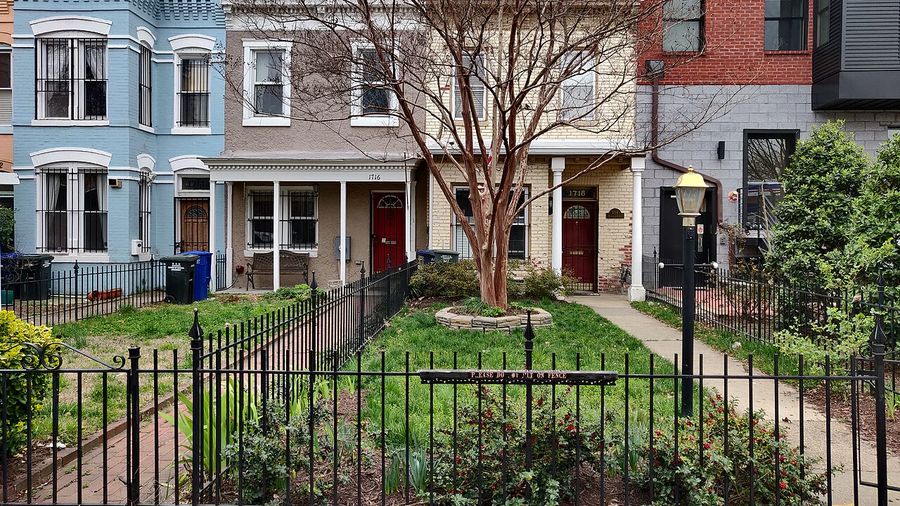
No-tax-return DSCR financing is a strong fit for investors whose personal income does not reflect their real buying power.
If the property needs renovation before it can rent, a bridge loan may come first, followed by a DSCR refinance once it is leased.
A DSCR loan is usually the simplest documentation path for a DC rental because it skips personal income verification entirely. Here is how the common options compare:
For investors with complex finances, multiple businesses, or a growing portfolio, the DSCR route often means fewer documents, fewer conditions, and a faster path to closing. The trade-off is that the property itself must support the payment, so choosing a well-priced rental with strong market rent is essential.
Qualifying is straightforward when you prepare the right information early.
Remember that DC rentals generally need a Basic Business License (BBL) for rental housing from DLCP. This is not legal or tax advice, so confirm licensing and tax questions with a DC attorney or CPA. Already own a rental with equity? Consider a DSCR cash-out refinance in Washington, DC.
Tell us about the property and the financing you need. We’ll respond with next steps.
DSCR Loans Direct is a trusted, top-rated lender serving Washington, DC investors, along with investors nationwide, from our office in Waldorf, Maryland. We underwrite on property cash flow and project viability, not W-2s or tax returns, and our team brings decades of hands-on real estate investing experience.
Call (866) 791-4411 or request a term sheet through our DSCR loan page. We finance single-family rentals, condos, townhomes, and 2-4 unit and multi-family properties throughout the DMV.
Questions
No, DSCR loans generally do not require personal tax returns. Lenders qualify the loan primarily on the property’s rental income compared with its monthly principal, interest, taxes, insurance, and association dues. That makes DSCR financing useful for investors whose tax returns show low income because of depreciation and business deductions. You will still provide other documents, such as bank statements, a credit authorization, and property information, so the lender can verify your down payment, reserves, and the rental’s income potential.
No, W-2s and pay stubs are generally not required for a DSCR loan. The program does not calculate a personal debt-to-income ratio the way a conventional mortgage does. Instead, the lender looks at whether the property’s rent supports the payment. This makes DSCR loans a practical choice for self-employed borrowers, commission earners, retirees with assets, and full-time investors. Expect to provide bank statements, entity documents if applicable, and an appraisal with a market rent schedule.
A no-tax-return DSCR loan typically requires property and asset documents rather than income paperwork. Common items include a purchase contract or mortgage statement, existing leases or an appraisal rent schedule, two or more months of bank statements, proof of insurance, and a credit authorization. If you close in an LLC, lenders usually ask for articles of organization, an operating agreement, an EIN letter, and a certificate of good standing. Exact requirements vary by lender and property.
Yes, DSCR loans are often an excellent fit for self-employed investors. Business owners frequently reduce taxable income through legitimate deductions, which can make it hard to qualify for a conventional mortgage. A DSCR loan sidesteps that issue by underwriting the property’s cash flow instead. As long as the rental’s income covers its payment and you meet the lender’s credit, down payment, and reserve guidelines, your business income documentation usually does not drive the decision. Request a quote to compare options.
No, a DSCR loan is not the same as an old-style stated income loan. With a DSCR loan, the lender still verifies the numbers that matter, including the property’s rent, the monthly payment, your assets, and your credit. The difference is that the income being verified belongs to the property, not to you personally. DSCR loans are business-purpose loans for non-owner-occupied investment properties and cannot be used to finance a home you live in.
DSCR loans often carry somewhat higher rates or fees than conventional owner-occupied mortgages, because they are business-purpose investment loans with flexible documentation. Pricing depends on factors such as credit score, down payment, DSCR, property type, loan amount, and any prepayment structure you choose. Many investors accept the trade-off for faster, simpler qualification and the ability to keep scaling. The best way to know your cost is to request a personalized quote and term sheet from your lender.
Yes, many DSCR lenders work with first-time investors, although some programs apply stricter terms to borrowers without rental experience. A first-time investor may see a lower maximum loan amount, a higher down payment requirement, or larger reserve expectations. Choosing a property with strong market rent and a healthy DSCR can help offset limited experience. Because DC rentals also require a rental housing license, new investors should confirm local rules with a DC attorney before closing.
Yes, many DSCR lenders will finance a vacant rental property using the appraiser’s estimate of market rent. The appraisal typically includes a rent schedule comparing similar rentals nearby, and the lender uses that figure to calculate DSCR. Some lenders apply tighter terms on vacant refinances or require a signed lease before closing. If the property needs significant repairs before it can rent, a bridge or fix-and-flip loan may be a better first step before a DSCR refinance.
Yes, investors commonly hold multiple DSCR loans because each loan is underwritten mainly on its own property’s cash flow. Unlike conventional mortgages, many DSCR programs do not cap the number of financed properties in the same way. Lenders may still review your overall experience, credit, and liquid reserves as your portfolio grows. For investors building a large DC portfolio, a portfolio or blanket loan may also be worth discussing with your lender as an alternative.
Ready When You Are
Tell us about the property and the financing you need — we’ll respond with next steps.
Call (866) 791-4411The same qualifying questions we use for an initial funding review, one step at a time.